
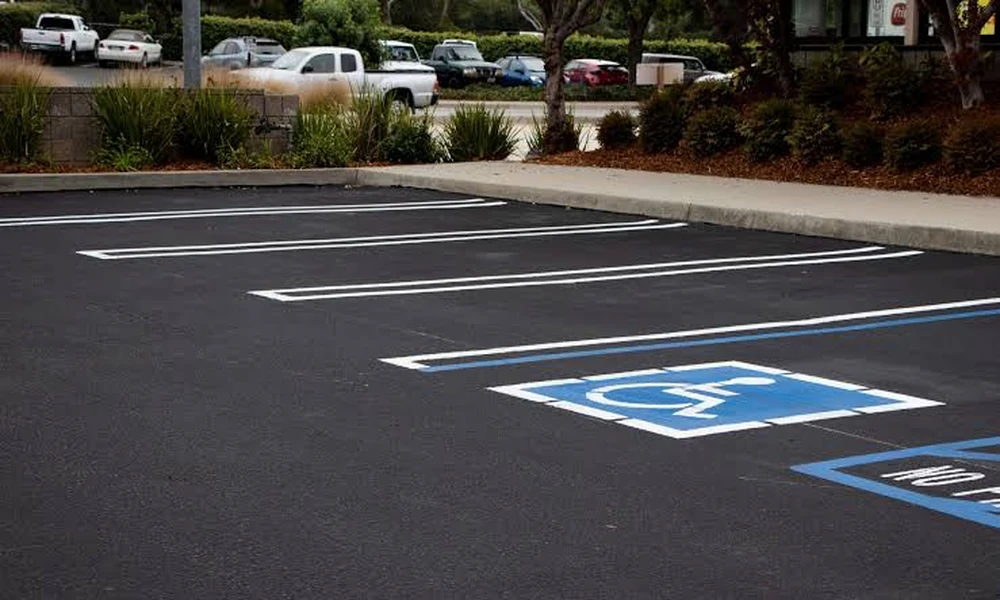

The Functional Role of Parking Lot Striping
Parking lot striping serves functions that become obvious when it fails: it maximizes the usable parking capacity of the lot surface, directs traffic flow in ways that prevent conflict between vehicles, establishes the pedestrian pathways that allow safe transit from car to building, and creates the fire lane designations that are required for emergency access. When striping fades to the point where these functions are unclear, all of these outcomes degrade simultaneously.
The ADA compliance dimension is the aspect most likely to create legal exposure for property owners who do not maintain their striping. Federal requirements for accessible parking are specific: the number of accessible spaces is a function of total lot size, the dimensions of the spaces and access aisles must meet defined standards, and the van-accessible designation must be maintained. Re-striping that updates the lot layout without confirming ADA compliance may not cure the violation; re-striping that proactively verifies ADA compliance with current standards does.
Utah parking lot striping services that include ADA compliance review as part of the standard scope – not as an add-on – demonstrate the operational completeness that professional striping contractors should provide.
Planning a Re-Striping Project
A re-striping project typically begins with a layout assessment – confirming the current lot configuration, identifying any areas where the layout is suboptimal, and verifying ADA compliance before applying markings that will be in place for two to three years. Making layout adjustments at this assessment stage costs only the design time; making them after new striping is already applied requires additional paint or thermoplastic and is significantly more expensive.
The scope of a re-striping project should be specified clearly: the number of standard stalls, the number of ADA-designated stalls (including van-accessible), the fire lane linear footage, any directional arrows or text markings, and the material to be used. This specificity allows accurate comparison between contractor quotes and provides the basis for verifying that the completed work matches what was agreed.
The ADA National Network Technical Assistance Center provides guidance on accessible parking requirements that can be referenced during the layout assessment phase to confirm that the planned striping will meet current standards – a resource worth consulting before finalizing any re-striping layout that includes accessible parking.
What Quality Striping Execution Looks Like
Quality striping execution starts with accurate layout. Lines that are parallel, evenly spaced, and properly dimensioned require either careful manual measurement or the mechanical layout tools that professional striping crews use to ensure accuracy across a full parking lot. Eyeballing layout or using informal measurement produces the visibly uneven result that characterizes poor striping work.
Line width and brightness affect both the visibility of the markings and the professional appearance of the facility. Standard parking stall lines at 4 inches wide in high-contrast white or yellow are the standard that makes a lot look professionally maintained; lines applied too narrowly or in faded colors look unprofessional regardless of the accuracy of the layout.
Weather conditions at application affect the durability of the finished markings. Paint applied to wet surfaces, in high humidity, or in temperatures outside the manufacturer’s recommended range adheres poorly and fades faster than paint applied under appropriate conditions. Contractors who monitor conditions and reschedule when appropriate are demonstrating the professional judgment that produces durable work.





Leave a Comment